Posts tonen met het label English. Alle posts tonen

vrijdag 8 februari 2019

Twitter #BookCoverChallenge


Do you have a Twitter account? I do (@Perkamentusblog), and recently I was invited by Helwi Blom (@HelwiB) to participate in the #Book CoverChallenge. I did Tweet a book cover every day (for 7 days) of a book that means something to me. You want to know why I did choose a particular book? Here they are again with a short comment and this time it's not about rarity or value, it's about emotions and memories.

Day I (30 January), I invited @fzwaan to participate in the challenge.

J.W. Watson: "Dinosaurs and Other Prehistoric Reptiles" (London, 1966).


I was just eight years old and received this book from my grandparents as a Christmas gift in 1969. I was crazy about dinosaurs and fossils and wanted to be an archaeologist! Of course I couldn't read English at that time so my grandfather wrote on every page in Dutch a short translation of the text below the beautiful illustrations by Rudolph F. Zallinger. I remember that I gave my first lecture with this book at primary school. My teacher was so impressed that I had to do it all over again in another higher class. Just a common book without any real economical value but very, very dear to me.

Day II (31 January). I invited @PaulHAMabels to participate in the challenge.

J. Wagenaar: "Amsterdam, in zyne opkomst, aanwas, geschiedenissen, voorregten, koophandel, gebouwen, kerkenstaat, schoolen, schutterye, gilden en regeeringe" (Amsterdam, 1760-1767).


My first old prints I bought at the Oudemanhuispoort (read this English blog!). These first acquisitions were separated book illustrations from publications by Jan Wagenaar (1709-1773), an eighteenth century Dutch historian. His history of Amsterdam (three parts, the fourth published by other historians many years after his death) is still very useful and famous. Since 2009 I am the proud owner of this splendid copy, bound in contemporary vellum. In the meantime I have become an avid collector of books by my 'book shelf hero' Jan Wagenaar. Read my blog post (in Dutch) about his rare obituary ("Een uitzonderlijk doodsbericht") and about a precious dedication copy I recently bought ("Idolatrie").
By the way... the first old book I bought from my pocket money was around 1976 and was a copy of number 13 (January 2019 acquisitions).

Day III (1 February). I invited @KimHeijdenrijk to participate in the challenge.


Ivans (J. van Schevichaven): "De man uit Frankrijk" (Utrecht, 1976).


My grandfather, an intellectual and avid reader, collected detective stories. He especially liked Simenon's 'Maigret'. On one of my occasional visits, more than fourty years ago, he showed me some new detective pockets he bought by Ivans (1866-1935), one of the first Dutch detective writers.
The "The man from France" (translated in English in 1921) was the first in a series of fifteen reissues published by Bruna between 1973 an 1980. Main characters are the English detective Geoffrey Gill and his Dutch sidekick mr. Willy Hendriks ('à la Holmes and Watson'!). Their adventures and the mysteries they encounter (and solve) all take place in Europe around the first World War. After I read "The man from France" I was hooked. When my grandfather died most of his books were given to a retirement home, but I kept all Ivans pockets as a sweet memory and I still reread them. Of course, being a bibliophile, I also have the original editions in my private library.

Day IV (2 February). I invited @Reindst to participate in the challenge.

dr. A Doedens, L. Mulder en A.C. Bijsmans: "Het dagboek van Sir Matthew Decker. Een Nederlandse Engelsman over Nederland in 1748 en een overzicht van de buitens in de 18de eeuw" (Baarn, 1987).


A long time ago I studied History and Dutch language at the V.L.V.U. in Amsterdam (to become a teacher at high school). This is my 'BEd', bachelor thesis (my 'promotor' was dr. A Doedens who had a publishing contract with Bosch en Keuning, together with the history teacher L. Mulder).
I discovered and translated "The Diary of Sir Matthew Decker" in Dutch and did most of the historical research (Decker was of Dutch descent, born in Amsterdam). At that time, in 1987, my thesis was the first V.L.V.U-bachelor study commercially published, and I'm still very proud of it. It is also the starting point for my love of research in historical archives (and collecting ephemera like this and these).

Day V (3 February). I invited @Loswerkman to participate in the challenge.

S. van der Werff en S.H. Woudsma: "Wat het hunebed vertelde" (Groningen, 1959).


I read this book at primary school around the age of nine. It made a profound impression on me and for thirty years (in a time without internet) I searched to find a copy. Finally, I found them (part A and B) in an abandoned school building.
The story starts with the friendship between a Roman and a Teuton boy. A noble man in the middle ages finds the account of their friendship written on parchment many centuries later. As a memento he makes five friendship rings and gives them to his children. "Wat het hunebed vertelde" ('What the megalith told') is the story of these five rings and their owners through history and time (and in the end the rings come together in one family again). I think this story is what made me an antiquarian. I can 'feel' the time that passed since an object was made and can connect with the story behind it. Just fascinating!

Day VI (4 February). I invited @ShahnilaShafiq to participate in the challenge.

"Thunderbirds album. Zomer 1966" (z.p. [Leiden], 1966).


Besides collecting (and reading) books I very much love watching science fiction movies!
I think my love for this movie genre started when I was around ten years old with TV Series like 'Batman', 'Thunderbirds' and 'Captain Scarlet and the Mysterons'. I still remember that I had a lot of books, postcards and Dinky Toys relating to these popular TV Series. In the course of time my interest shifted and my Sci-Fi collection disappeared. I started to buy and to collect again some old Thunderbirds memories (comic books and postcards) around 1985. It is not a focus point of my bibliophilia anymore but I'm glad to have them back again as I wrote in "Herinneringen kopen" ('Buying memories').

Day VII (5 February). I invited one of my Twitter followers to volunteer and @MattijsGlas took up the challenge.

J.R.R. Tolkien:"In de ban van de ring" (Utrecht, 1997).


I remember that my father borrowed me his 'Prisma' copies (three parts) of this famous fantasy book when I was around 20 years old. I rarely buy or read fiction, but "The Lord of the Rings" is one of the classics that I like to reread every once in a while. Twenty years ago I bought my own copy (on the right). Of course I saw the movies made many years later by Peter Jackson (and I quite liked them). The world's first translation of "The Lord of the Rings" appeared in the Dutch language in 1956/57. 
As a bibliophile I still fancy a first edition with dust jacket in Dutch, but they are quite expensive. Patience my precious dear, patience...

Did you enjoy this English blog post? Look here for some more!

vrijdag 19 september 2014

Linguistic adventures


Some years ago I bought a copy of “Bizarre Books, a compendium of classic oddities”
(New York, 2007). Books like that are not only fun to read but also very useful as a reference work when hunting for ‘bizarre books’. Books with funny titles, obscure topics and unusual stories, especially the older ones, make me curious and greedy. Most of them are hard to find though.

The first title I bought after reading ’Bizarre Books’ was a “Handbook on hanging” (London, 1928). Thanks to internet it came all the way from a little brick and mortar bookshop on Isle of Arran (of all places…) to my private library near Amsterdam.


But the book that really caught my attention was “An Irishman's Difficulties with the Dutch Language” (Rotterdam, 1908) by ‘Cuey-na-Gael’.
This curious pen-name ‘Cuey-na-Gael’ used by the English Rev. John Irwin Brown (1858-1937) deserves a comment. It is a Gaelic phrase identifying a native speaker of Gaelic, a member of the Gaeltacht a language group that includes both Irish and Erse, the language of the Scottish Highlanders. 'Cuey-na-Gael' is perhaps best represented in translation as "Hugh the Scotchman", given Irwin Brown's devotion to all things Scots, or as he always put it, 'Scotch'. Brown was a well-known clergyman for the Scottish church in Rotterdam (The Netherlands) and fluent Dutch speaker.

His book became very popular because he toured the Netherlands promoting it by giving lectures about funny situations caused by misunderstandings and misinterpretations while communicating in the two languages.
Some years later Brown published a sequel; “The Further Adventures of O'Neill in Holland” (Rotterdam, 1910). Both are not illustrated, only the linen book covers show the main character with pipe in trench coat and the typical English bowler hat approaching locals (a woman with traditional Dutch cap and a baker’s boy) with presumably a dictionary in his hands. The bookbinder for the sequel was G.F.L. Ophof in Rotterdam, the drawing was signed by C. Eberle (the binding and drawing of the first book are anonymous). The books - especially the first - were reprinted several times (the last edited and annotated edition by Robert Druce was published in 2000!).
Both titles are digitally available online (click on the titles!) but of course I am – like every bibliophile would be - much happier with the original paper copies in my library (a 7th edition of the first and a 2nd edition of the second book).


The main character in Brown’s books is an Irishman called Jack O’Neill. Now Jack may be Irish by birth but in his language he is definitely English since I could find no trace of typical Irish words in the text! O'Neill decides to spend his holidays in The Hague to get a good general acquaintance with Dutch Literature and – as promised to his friends - ‘to master the language in the first fortnight’. To accomplish this he buys some antiquarian Dutch-English/English-Dutch dictionaries, some grammar-exercises as well as phrase-books, one of those being: ‘Boyton and Brandnetel’.

“That book was all O’Neill told us, and more. Printed on paper that seemed a cross between canvass and blot-sheet, it bore the date 1805. It was very Frenchified, and the English puzzled us extremely. Here is the Preface – or part of it.

The following WORK was, originally, compiled by William Boyton. After passing five Editions a Sixth appeared partly enlarged, and partly improved, by Jac. Brandnetel. This last Edition was published, at the Hague, in the Year, 1751.
The several particles, of Speech, are arranged by the usual Order; and Declare with precision; every rule being followed, with practical exercise. This Mode, of teaching, being already appreciated; it will not be deemed Essential; nor do we, point out, the utility of it. As to Syntax; it is fully treated: whilst, last not least, cares have been exercised, to unite ease with simplicity, accuracy with idiom, and animate the Learner. It aims at the pupil of High-Life, and to acquire the Polish of the civilized Lady.

THE HAGUE, 1805.


This brilliant introduction raised our expectations to fever heat. We had never encountered such an army of commas before; and as for the English -!”.


No need to tell you that Jack gets ‘lost in translation’ combining (old) words with his intuition to fabricate sentences appropriate for very specific situations, posting letters for example (I added the English translations of some Dutch words between brackets).

“Two common English verbs I found very difficult to render exactly. These were ‘drive’ and ‘put’. ‘Put’ you have to use so often that it is certainly provoking to hunt for a new verb almost every time you have a fresh order to give. ‘Put it down’, ‘put it in the cupboard’, ‘put it in the hall’ – well, I managed these somehow. But when it came to having letters posted, I was a long time at sea. I wrote a good deal; and ‘put that letter in the box’ was a common order I had to give. Now ‘box’ was easy enough, for the receptacle in the street was duly labeled ‘Brievenbus’ [Mailbox]. But when I said, ‘Plaats dien brief in de brievenbus’ [Locate the letter in the mailbox], the maidservant stared at me as if I was hardly human. ‘Zet’ [Place] and ‘Werp’ [Throw] were not much clearer, apparently. ‘Gooi’ [Toss], I must admit, always made her perform the task with alacrity, but with an air that plainly said the matter was not very serious”.


At the beginning of the twentieth century English books for the Dutch book market were rather scarce, most of them being dictionaries and grammar books for pure educational purposes. In that respect Brown's books were unique and as C. Heyman, a schoolteacher in Haarlem, wrote: “highly appreciated by all Dutch people who are trying to master the difficulties of English, and often despair of finding the right word for the right place. To all such it will be quite a treat to see how their vernacular puzzles your fellow countryman. The booklet fully deserves a place in the libraries of our H.B. Schools and Gymnasiums, and is sure to find one there”.
The fact that they were published for the Dutch market and became very popular shows us at what level English functioned as a second language for a growing number of people over here at that time. Even Jack O’Neill had to admit: “There is no chance of practice unless you get away from everybody that speaks English. That was not too easy, I tell you”.
For us – the Dutch – speaking English nowadays has become a second nature and English has been our ‘lingua franca’ for almost two centuries.

While browsing the internet for information about ‘Cuey-na-Gael’ I stumbled upon a stunning similar title: “A Dutchman’s Difficulties with the English Language” (London, 1865). Published almost fifty years before Brown’s book! I was fortunate enough to be able to buy a copy of this very rare little book once belonging to the public library in Haarlem. According to Worldcat only two copies remain at public libraries in the Netherlands, one in the United Kingdom.
The short anonymous published story – in the form of a letter - apparently is a reprint of “Good Words”, a well-known Victorian monthly periodical in the United Kingdom.
The author, we now know, was Jan de Liefde (1814-1869), not only Dutch but a clergyman as well! This in combination with the almost identical title leads me to the conclusion that Brown must have been well aware of De Liefde’s story.


“A Dutchman’s Difficulties with the English Language” is about Steven van Brammelendam, who struggles with his English in London. But in spite of the identical book title Steven is in no way comparable to Jack O’Neill. Yes, he too makes mistakes “more amusing than perplexing” but he also turns out to be a linguistic genius when debating his English friends about the inconsistencies and anomalies of their language.

“Indeed’, one of the ladies observed, ‘it never struck me that we used our prepositions in such strange way. It really must be perplexing to a foreigners to learn all such irregularities’. ‘Oh, I am disgusted from them’, Steven replied in a joking tone.
‘With them!’ several voices burst out. ‘With them?’ Steven repeated. ‘Do you say, ‘I am disgusted with that drunkard?’ ‘To be sure we do’. ‘Well, that is most absurd.
We Dutchman are disgusted from him; we do not want to be with him at all. Disgust seems to bring forth a strange effect in you; it drives you to be with the object which you dislike. I suppose you consequently say, ‘I am pleased from my wife and children.’
‘No, no – with!’ the gentleman cried. We are all of us pleased with our wifes. No mistake about that.
”

Today foreign tourists in the Netherlands don’t need to bother about the Dutch language. ‘Excuse me; do you speak English?’ has become nothing more than a polite opening phrase. No need to ask, of course we speak English. However, in case you actually wish to practice your Dutch language skills, you are most welcome to try and see what happens.....


Did you enjoy this English blog post? Look here for some more!

vrijdag 6 juni 2014

Being an 'Ai Sho Ka'


Do you buy books you cannot read?
I normally don’t. But this time I couldn’t help myself and paid almost two hundred fifty US dollars (€ 175,- euro) for three books in Kanji (logographic Chinese characters used in Japanese language) printed on very thin paper and traditionally bound in yellow embossed paper wrappers. Why?

Well first of all because I am a Bibliophile (which according to my partner is synonym with ‘totally nuts’). I like books in all their different forms and aspects and I was struck by the fragile but beautiful appearance of the three volumes. Secondly because I was intrigued by the incomprehensible text and the numerous interesting illustration.

The bookseller couldn’t tell me very much about them. Most of the stuff he sold on the little ‘Spui’ book market in Amsterdam was about European Art nouveau and Art deco.
I leafed through the books and found in one of the volumes a little paper telling me that this was an edition of the ‘Hakubutsu Shinpen’ printed in 1874. I decided to take a chance, and bought them.


For me every old book is an adventure that has to be explored. As usual my exploring started at home behind the computer. I soon found out that this was indeed a copy of the ‘Hakubutsu Shinpen’ (‘Book of Natural History’) written by Benjamin Hobson (1816-1873) and originally published in Shanghai in 1855 as ‘Bowu xinbian’.

Benjamin Hobson was a British missionary doctor who spent two decades (1839-1859) in China. He founded hospitals in Hong Kong, Guangdong and Shanghai; trained local physicians in Western medical techniques; and wrote several medical and scientific textbooks in Chinese based on European sources, including this book of Natural History.

The Japanese versions of Hobson's works appeared early Meiji period (1868-1912), a critical time in Japanese history, when the country ended its isolationist foreign policy and began opening its ports to Western trade. The text conveying scientific knowledge that had developed in the West was warmly welcomed in Japan and very popular. It was repeatedly printed and published in numerous editions.


With the help of my Japanese Twitter friend and Shodo lover Masuto Nanami I learned that the text must be read from top to bottom down a column, and right to left across columns. He translated some words for me too and showed me how to write ‘Bibliophile’ or "Ai Sho Ka" in Kanji. The three characters: 愛書家 are (from left to right) for ‘love’ (Ai), ‘book’ (Sho) and ‘Ka’ (person). Look at his video, seems easy, huh?

‘Hakubutsu Shinpen’ is divided into three parts. The first book (67 folded leaves), on physics, has sections on topology, heat, water, light and electricity. The second (30 folded leaves) is dedicated to astronomy and the third (34 folded leaves), entitled "Outlines of Birds and Beasts" is devoted to natural history. All three parts are illustrated by an anonymous artist.


The books are an example of traditional Japanese woodblock printing. In case of two text pages every woodblock had a total of 21 vertical columns with characters carved out, including a central column with the book title, part- and page number (see picture above). After printing the sheets were dried and folded oriental style; ‘Fukuro toji’. The bookbinding is typical Japanese style; ‘Yotsume toji’.


The title page of my ‘Hakubutsu Shinpen’ is divided into three vertical columns and has an elegant border. The text outside on top indicates that this is the 3th edition published Meiji 7 (1874). The big letters characters in the middle are the title. The publishers name is in the left column; ‘Yorozuya Heishirō’ (Tokyo) with at the bottom his red seal stamp (in Japan called ‘Yagō’). At the end of part three there is another page with a special border and text. This is a list of the bookstores and their owners in Osaka and Tokyo.
As you can see on the picture below corrections (within a little border) are separately carved  and printed just outside the wood block text above the appropriate column. Right next to it you see some personal remarks by a previous owner written in black ink.


Most of the numerous woodblock illustrations look quit primitive but my favorite one, this railway locomotive, is very precise and detailed. Astonishing don’t you think so?
Remember that at that time (1874) for the readers in the ‘far east’ this illustration must have been their first acquaintance with a locomotive and railway. Railway history in China had to begin, and had only just begun in Japan (with a railway line in 1872 from Tokyo to Yokohama).


It is my first specimen of an old oriental book printed on rice paper (most likely ‘Washi’) in my collection. Leafing through the books I keep amazing myself about the soft paper with the mysterious printed characters and the beautiful woodblock illustrations. It is a feeling difficult to explain but I think it is similar to the amazement and admiration that the Japanese readers must have felt one and a half centuries ago.
For both of us it is a kind of ‘first contact’. For them with the wonders of foreign worlds and unknown knowledge, for me with the art of book printing and publishing in the Far East.


Is this 1874 edition of ‘Hakubutsu Shinpen’ rare or valuable? That depends! According to Worldcat there are five copies in public libraries in the United States (and this online edition in the Waseda University Library in Tokyo) but none in Europe.
As for the antiquarian book market I am sure you can find an edition using the internet.
I quickly found one on Ebay sold for less than I paid and another similar, 1872 edition, in the catalogue of an American antiquarian book dealer for a lot more.

But honestly, it doesn’t really matter to me.
This isn't about value or money. It is about the beauty of an object so different from what I am used to find on book markets. It is about the joy this book gives me as an “Ai Sho Ka” even without properly understanding it’s content. And finally, it is about learning from each other, then and now.


Did you enjoy this English blog post? Look here for some more!

vrijdag 14 maart 2014

The Rembrandt connection


I have not been to the new Rijksmuseum yet.
I saw the documentary about its ten year renovation on television. I watched the opening ceremony on television too and I have heard from people who have been there that the museum is very beautiful. I am deliberately delaying my visit. I am feeling a bit uneasy because I know that they are still there, but not exactly where. I know that they will look at me, just as they did the first time. They will remind me of my promise and I will feel guilty, fall silent and won’t have a proper answer.

I know, I know, you don’t understand, but let me explain about my ‘Rembrandt connection’, well, not with him personally but with one of his paintings.

It happened nearly forty years ago, when I was fourteen years old. Almost every Sunday I would go alone by bus to the Rijksmuseum. I had a ‘Jeugdmuseumkaart’, a free entrance card to several Dutch museums especially for young people from 11 to 21 years. It cost only one guilder (about half a Euro!) and every year it came in a different colour.
A cheap bargain. Oh yes, those were the days! Let me show you the pink coloured one of 1975. It is still in my scrapbook as a memento of my curious experience that year.


Of course with a card like that you were not allowed to use the main entrance, oh no!
You had to enter through the back entrance, the quiet part of the museum. And with the quiet part I do not mean the exterior but very much the interior too! In those years the Asiatic Art section was housed there.
There were rarely any visitors and almost no museum guards. Why would anyone want to see, let alone steal this incomprehensible art? I would quickly sneak my way through small corridors, empty halls, narrow passageways, steep staircases and then hear voices as I approached the more lively front part of the Rijksmuseum. Suddenly there would be lots of people, most of them tourists, all wanting to see old Dutch master paintings, especially Rembrandt’s famous ‘Nachtwacht’ (The Night Watch).

During one of my visits in 1975 it happened.
I remember that it was a warm and sunny day and I felt tired of walking and with all the impressions. As I was not especially interested in old master paintings I walked around aimlessly and happened to enter an empty and quiet room. I sat down, looked up and saw them. The ‘Staalmeesters’ (Syndics of the Drapers' Guild) painted by Rembrandt van Rijn in 1662. Six stern-looking gentleman dressed in black, five with tall black hats.
Was it my imagination or did they really look at me? I felt... drowsy…


Suddenly I heard a loud voice: “Frederick? You may come in boy”. It was Frans Hendricksz. Bel addressing me. He was their servant and lived in the house. A few minutes ago he had opened the door downstairs for me. Slowly I pushed the polished oak door and entered the room. They looked inquisitively at me. Frans wearing his black ‘kalot’ (zucchetto) was standing in the center behind them. Volkert Jansz. Had risen from his chair and whispered to Willem van Doeyenburg; “This is the boy I told you about”. Willem had his hands on a book lying in front of him on the table. Aernout van der Mye, who was sitting next to him, was holding a page as if he had just been checking it.

A stern voice asked: “Well? Where is it?”
I felt small and uncomfortable. “At home, master.” Silence…
“Where did you find it?” Now I am sure this was Jochem de Neve.
“In a rabbit hole master…” They looked surprised.
“Where do you hide it?”
“I keep it in a wooden box master, ever since I found it three years ago”.
“Speak louder boy. When will you give back what belongs to us?”
I tried not to whisper and mumbled: “I… I don’t know master; soon I promise, soon”.
A long silence passed, then Frans Hendricksz. Bel spoke to me again: “Be gone boy, these gentlemen have work to do and remember: a promise is a promise”.
The heavy oak door closed with a loud bang and I … woke up.


I know, I know, this is not making any sense, but wait.

Three years earlier…
It was 1972 and I was walking with my mother, a friend and his dog not far from my home on the empty and desolate sand slopes put there long ago. You would no longer recognise this place because today the A10 motorway runs here and the economic heart of Amsterdam, the ‘Zuidas’ (South Axis) has totally covered up the empty landscape of my youth. Look at the pictures below taken from exactly the same spot in 1968 and 2013 and you will see what I mean.


It happened behind that tree line on the far right in the picture above. I had my shovel with me. I desperately wanted to be an archaeologist. As a child I didn’t play or like football as normal kids did at my age, oh no. I liked to read about dinosaurs, collect animal bones, coins, antique stuff, to dig in the ground and read history books. Anyway, I was poking around in a rabbit hole with my shovel when something dropped out of its roof. It was round and heavy and looked like it was made of lead. I could see an inscription on it, the insignia of Amsterdam and two dates: 1669 and on the other side 1674. I immediately realised that this was important: “Look ma what I have found! Oh I’m so happy, so happy.”

A few weeks later my mother and I visited the Amsterdam Museum where I met Michiel Jonker (1948-2014), the deputy curator. I think he found me amusing. Reluctantly I left my precious treasure with him for research and to have pictures taken of it. A few weeks later I received his letter.


What I had found was in fact a ‘Lakenloodje’, a lead textile seal used as quality assurance by the Syndics of the Drapers to mark their fabrics. It was not just one of the many in the collection of the Amsterdam Museum but an important piece, very well preserved, and on top of that a rare (2.5 inch) ‘anderhalf stael’ seal only used for top quality textiles (the superior quality seal being a ‘dubbel stael’). The museum wanted to buy it from me for their collection. They offered money so that I could buy a motorcycle (!) but I refused.
For me to posses a museum piece at the age of eleven was far more interesting than a motorcycle I was not yet allowed to drive for another seven years!

Thirty years later…
I was in a bookshop and it was by accident that I leafed through the annual bulletin of the Amsterdam Bureau for Monuments & Archeology 2003. No, I had not become an archeologist but instead studied history. Suddenly I saw a familiar black and white picture. An illustrated article by Wiard Krook on sixteenth and seventeenth century Amsterdam lead textile seals ("Staalloden. Zestiende- en zeventiende- eeuwse Amsterdamse textielkeuren", p. 45-53). Yep, there was my treasure and according to Wiard’s text still an important textile seal!


I smiled when I read in his article; ‘Found in 1974 by an ‘Amsterdammer’ in his garden!’. Wrong year, wrong place. We lived in an apartment with a five square meters concrete balcony!
The annual is in my library now and the lead textile seal? It is in the same wooden box where I put it over forty years ago. It is a shame that it very rarely sees daylight and I feel more and more the need to donate it to the Amsterdam Museum as such an important historical artifact should be in a public collection, accessible to everyone, instead of being locked away in a wooden box.

I am grown up now and no longer afraid of Rembrandt’s painting ‘Syndics of the Drapers' Guild’. I had this dream, my 'Rembrandt connection', only once and a long time ago, but whenever I see these stern gentlemen dressed in black I still feel a little uneasy and guilty.
Is it my imagination or is Frans Hendricksz. Bel really whispering to me: “Remember: a promise is a promise…”

Did you enjoy this English blog post? Look here for some more!

vrijdag 27 december 2013

Holy Ground

Ever been in Amsterdam?
As in every European city there is much to see. Beautiful old buildings, the historic canals (Amsterdam is one of the cities called ‘Venice of the North’!) lots of museums, history and art. For booklovers there are some great old book shops and flee-markets. People are friendly, and - guess what? - with few exceptions everybody speaks English too!

Especially in the summertime it can be very busy and crowded. For some attractions like the Van Gogh museum or Anne Frank House it really doesn’t make any difference. Summer- or wintertime, there’s always a long queue of waiting visitors.
If you are stuck in one of those and you are tired of waiting, tired of crowded places, tired of seeing too much in a time too short. If you need some time to rest, a place where your mind can get some peace, let me take you to a more silent and forgotten part of the town.


Let’s go to the Oudezijds Achterburgwal and take a look at this old gate, the ‘Oudemanhuispoort’ (‘Old-Man-House-Gate’ or in short ‘The Gate’). The complex behind dates from 1602 was rebuilt several times and originally housed poor old men and women but in 1880 the University of Amsterdam moved in. A century before the corridor along the south façade of the building was turned into a covered passageway (just behind this gate) with eighteen little shops for rent. They were called ‘winkelkasten’ (‘winkel’ = shop and ‘kasten’ = cabinet) because the niches were too little for a shop and too big for a cabinet.

Luxury items were sold here, like jewelry and precious metals. These articles gave the passage for a short time the allure of a grand shopping street. In 1879 the nearby ‘Botermarkt’ (Butter market), now Rembrandt Square (with his bronze statue) was shut down and the book merchants, called ‘book Jews’ because most of them being of Jewish religion, had to move to another place. Many restarted their book business in one of the ‘winkelkasten’ in The Gate.


Undoubtedly the most famous 'book Jew' was Barend Boekman (1869-1942). January 21st. 1939 he celebrated together with his colleagues his seventieth birthday in The Gate, along with his fiftieth anniversary as a book trader there. But happy times in Mokum, the Jewish nickname for Amsterdam, were not to last.
By the end of that year World War II started and in May 1940 Germany occupied the Netherlands. Jews were excluded from Dutch society and it became impossible for Jewish merchants to continue their business. Prosecutions started, daily roundups followed and bounty hunters roamed the city. More than 100.000 Dutch Jews were deported to the German concentration camps and never returned. Among them Barend Boekman and his wife. Both died in the gas chambers of Auschwitz on September 14th. 1942.

A Dutch Jewish bookseller who survived the Second World War was Menno Hertzberger (1897-1982) one of the founding fathers of the International League of Antiquarian Booksellers (ILAB) and the Dutch Association of Antiquarian Booksellers (NVvA).
Ten years after the War ended Hertzberger published a small book, by F.J. Dubiez; “Barend Boekman van de Oudemanhuispoort” (Amsterdam, 1955), to commemorate this colorful person. It is a limited edition of only 100 copies and some years ago I was lucky to find number 73.
It’s by far not the most expensive book in my library, it has no luxury binding and no color illustrations. It’s not fancy at all but still it’s one of my favorites, a wonderful and vivid memory of the 'book Jew' Barend Boekman and his time.


As Dubiez aptly wrote: “With the passing of Boekman and his colleagues from The Gate , something was lost. A specific atmosphere. An atmosphere indispensible for the true book-lover and -collector. It’s something he can’t live without and doesn’t want to miss because he needs it”.

Times changed, peoples changed, almost everything changed.

In my teenage years, the seventies, there were still booksellers in The Gate. Sometimes no less than six or seven of those little shop cabinets were open, and then there was of course the famous shop of Pfann; “In 't Oude Boeckhuys” ('In the Old Bookstore’).


Pfanns’ little shop started in 1924, just outside the passage, in the open part of The Gate near the Oudezijds Achterburgwal (take a look at the illustrations). Founding father of this family of book- and print sellers was Hendrik Daniel Pfann I (1889-1957).

Everybody knew Pfann.
Like Boekman he was a very colorful person, with wild black hair and big mustache, always wearing his long velvet coat, jaunty flambard or black bowler hat. He was a teetotaler, didn’t smoke and wasn’t Jewish either (a novelty in The Gate!) but instead an active member of the Salvation Army. In 1949 Pfann celebrated his silver jubilee in The Gate.
According to Dubiez he was “not only a bookseller but also a passionate collector and an equally large book connoisseur as the old Barend Boekman”. Pfann was the last of his time, the last old book trader in The Gate. “When this last great figure is gone”, Dubiez wrote, “when this last significant bookseller has disappeared from The Gate, a sympathetic and romantic past has come to an end”. That moment finally came in 1981.


Times changed, peoples changed, almost everything changed.

What is left are my memories and black and white postcards from the fifties, sixties and seventies next to some artist impressions by Anton Pieck (1895-1987), one being a ‘Dickens’ fantasy, the other more realistic.

Nowadays The Gate is a somewhat dim and windy passageway. If your lucky there are two or three book niches open (one of them specialized in cookery books). But most of the time it’s just an empty passage for University Law student and some peace seeking tourists like you.

For me it’s a very special place. Here, more than forty years ago, I was infected with Bibliophilia, a ‘Gentle Madness’. It’s also a place full of memories and important in a cultural- and (book) historical sense.
Be silent for a little moment take a deep breath and relax, this is Holy Ground.


Did you enjoy this English blog post? Look here for some more!

vrijdag 15 november 2013

A square inch of art


Surprise, surprise!
Though I have written some ‘guest editorials’ in the past (look here!) this will be my first piece in English on my bookish blog Perkamentus. Let me first I apologise to my (few) Dutch readers who can’t read English! I promise to keep it short with almost no text and lots of illustrations.

As some of you have probably noticed I started sometime ago with English tweets. Soon I gained some foreign followers who, I’ am afraid, don’t read or speak Dutch. One of them is Lynn Roberts from the ‘The Frame Blog’ who was kind enough to pre-read my piece (thanks again Lynn!).
Now most of them are interested in art and history (but not necessarily in old books).
I‘m an art lover too but first and foremost a bibliophile so the idea of writing a piece that combines ‘the best of both worlds’ was soon born.

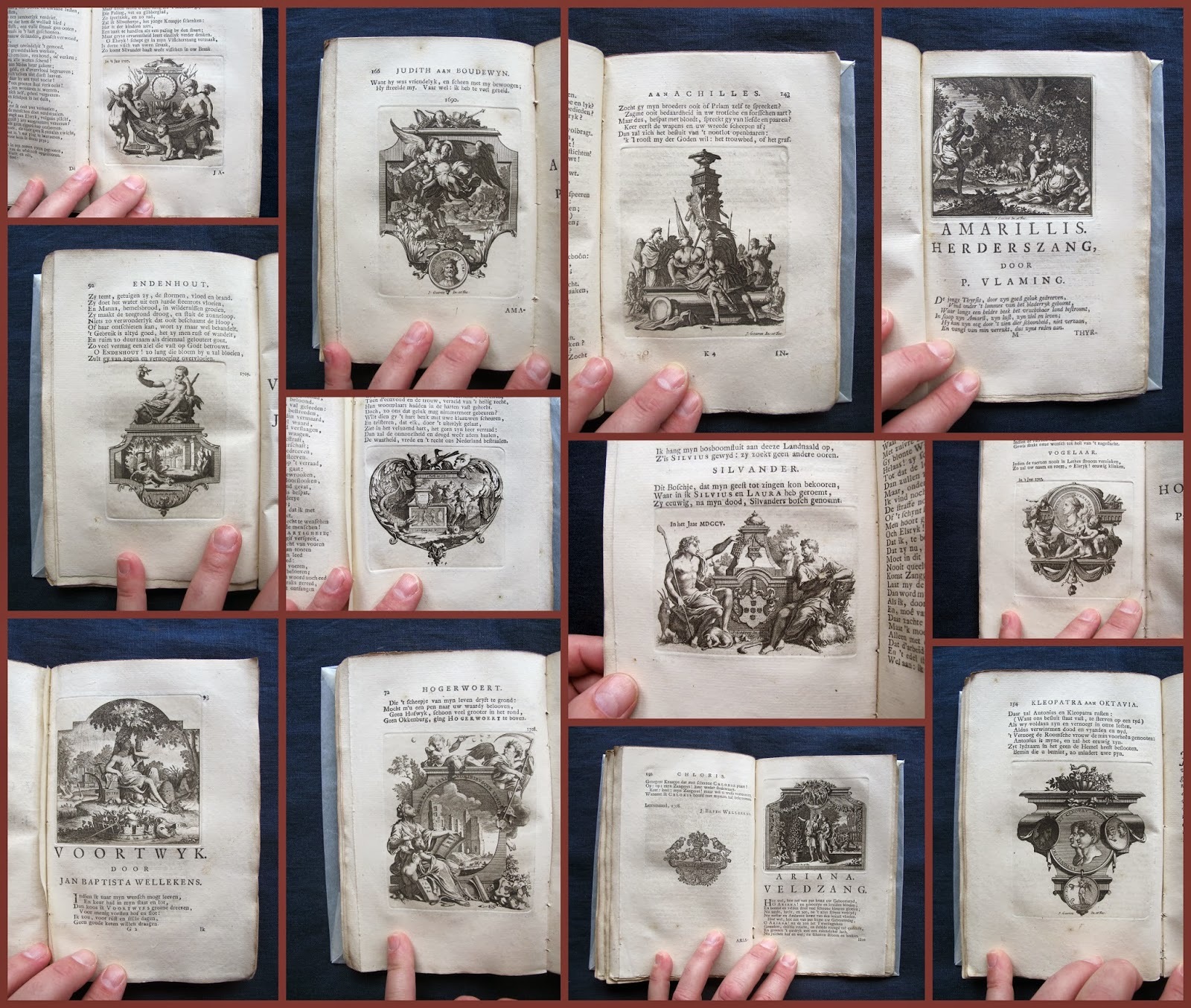
This blog post is illustrated with some examples of engraved head- and tail-pieces I have encountered in my old books (all titles present in the Short-Title Catalogue, Netherlands). Although they have never been a special subject on my blog yet I will refer to two previous illustrated posts to make as much room as possible for new illustrations here. By the way, about my photo fingers, they are just there to give you an impression of their size (I mean the head- and tail-pieces, not my fingers!).


Head- and tail-pieces are book decorations and most of them not bigger than a square inch. In most modern books they have been dispensed with, or sometimes reduced to a simple line, dot or star but in handmade private press books you can still find them.
In the 17th and 18th centuries they were quite common and my impression is that you will find them more often in books about art or poetry than in pure science books.
Many of the original tools used for book printing and book illustrating from those centuries have not survived. Probably one of the world’s most interesting and biggest collections of old type-ornaments like head- and tail-pieces (almost 9,000 items) can be found in the Museum Enschedé in Haarlem. A few examples from this collection are reproduced in: “Type foundries in the Netherlands from the fifteenth to the nineteenth century” (Haarlem, reprint 1978, page 357-362) by Charles Enschedé (1855-1919).


What exactly are head- and tail-pieces? Well, headpieces in books are type-ornaments at the head of a chapter or division and tailpieces are - guess what? - type ornaments at the end of a chapter or division (note: exactly the same sort of motif is often used as so-called ‘vignette’ on typographical title pages).

Originally these kinds of illustrations were woodcuts but by the end of the 17th century most of them are engravings on copper. Is there some way of classifying them? Yes! “Head-pieces (like tail-pieces and initials), may be divided into two classes—first, those enclosed within a parallelogram or other regular figure; and secondly, those which are free or irregular in outline. The first class is again subdivided into those with solid or stippled background, and those in which the background is white. In some specimen-books the same device may be found in three forms—enclosed in a boundary-line with solid background; in boundary line without ground; and free—the boundary line removed” (in “Typo: A Monthly Newspaper and Literary Review“ (Volume 2, Issue 20, 25 August 1888).

They come in all kind of different forms and variations. Some have reference to the text, but most are entirely fanciful. Some simple tailpiece examples are shown below (click on the images to enlarge!):


Others are tiny framed scenes, like these seven from a book (a laudatory poem on the river Amstel) by Nicolaas Simon van Winter (1718-1795); “De Amstelstroom, in zes zangen” (Amsterdam, 1755).


If the headpiece is as wide as the text block below we speak of a ‘headband’, rather than a headpiece, like the one on top of this blog post! A good example of a beautiful headband is the one I found (look here!) in: “Noodsakelyck wereld-haten op de woorden Christi.” (Amsterdam, 1634), by the Dutch Catholic playwright Jan Hermansz. Krul (1602-1646). This one together with the tailpiece used in the same book is especially interesting because we find both pieces together eight years later as a single tailpiece in Pieter Corneliszoon Hooft’s (1581-1647) famous history book: “Neederlandse Histoorien“ (Amsterdam, 1642). Since they are printed by two different presses it shows us that printingtools, borrowed, purchased, inherited or otherwise acquired often wandered around.


Most head- and tail-pieces are elaborately braided ornamental forms, others are more or less pastoral scenes, flower arrangements or portraits. For some very delicate examples, take a look at the illustrations (here!) in a previous blog post I wrote on the rare erotic poetry debut of Willem Bilderdijk (1756-1831). This first edition is normally illustrated with 28 little head- and tail-pieces all engraved by the author himself (which is quite extraordinary). Only three copies I know of have an extra 29th tailpiece with his motto “Semper Idem”, two of them in a public library, one in my collection.

The biggest and most sumptuous head- and tail-pieces in my library are found in two books. The first is by Jan Baptista Wellekens (1658-1726) and Pieter Vlaming (1686-1733): “Dichtlievende Uitspanningen” (Amsterdam, 1735). In this octavo edition the pieces are proportionally very big (sometimes 3.5 x 4.5 inches). Many head- and tail-pieces for these laudatory poems of some long-gone estates near Amsterdam show us monumental garden pieces and thus have a direct relation with their subject. In this case several pieces are not only signed by the engraver (and poet) Jan Goeree (1670-1731), but also dated!


The second book is a folio edition of an art historical work (about antique tokens) by the painter and historian Frans van Mieris II (1689-1763): “Historie der Nederlandsche Vorsten” (‘s-Gravenhage, 1732-1735). His headpieces are everything but small (7.06 x 5.15 inch) and there is one in every volume for every first chapter. All three show us scenes packed with symbolic figures and attributes and are very beautifully framed.


Like the headpieces the tail-pieces (below) in these volumes are signed too, by Jan Wandelaar (1690-1759) or Bernard Picart (1673-1733) both famous engravers in their time.


What’s very interesting in these books is the endnotes in volume two and three with a calculation (“Uitreekening”) of the different costs made for paper and illustrations.
The big headpieces (“Het Vignet aan het hoofd…”) cost ten cents and the tailpieces (“Vijf Vignetten…”) two cents each and were probably specially made for this work.
This reminds us that books in those days were something different than the ready-made stuff you find in your local bookstore nowadays! Text and illustrations were separately printed (and paid for) and then there remained the question of an (often expensive) bookbinding!


Did you enjoy this English blog post ? Look here for some more!


donderdag 28 april 2011

Guest editorial 3

Primeur voor The Private Library (en mijn derde bijdrage); ‘Going Dutch at the Private Library’ (helaas offline).
Vanaf morgen ook hier te lezen; ‘Typisch Nederland(s)’.

maandag 24 januari 2011

Guest Editorial 2


Mijn eerste guest editorial voor The Private Library (helaas offline) riep verschillende positieve reacties op.
Daarom besloot ik één van mijn avontuurtjes (“Een bijzonder vorstelijke vondst”) te bewerken en te vertalen. Vanaf vandaag dus ook voor de Engelstalige bibliofiel ‘Serendipity and the Private Library’.